Jira QuickView User Guide
Hover Jira keys on GitHub, Gmail, Outlook, docs, and other enabled pages to inspect issues, follow linked PRs, comment, transition, and edit fields without opening a new Jira tab.



Download Extension · Extension website · User guide · GitHub repository · Issue tracker
Jira QuickView lets you work with Jira issues directly from the web pages where issue keys appear. Instead of opening Jira in a separate tab for every notification, pull request, document, or checklist, you can open QuickView from an issue link—or optionally hover a recognized key—to inspect, update, comment on, and triage the issue.
The screenshots in this guide are examples. Your popup can look different depending on your Jira project, your permissions, your workflow, and the layout you choose in the Options page.
What's new in 2.9.2
- The links panel now shows children (sub-tasks and epic children), linked issues, and external links in three sections, and its count includes all three.
- External links, such as test cases or Confluence pages, open in a new tab and can be removed from the panel.
View in Jirain the panel header opens the issue's links in Jira;View allopens the children or linked issues as a Jira search.- Long issue titles in the popup header stop at two lines.
Fixed in 2.9.1
- With click activation on, clicking an issue key on a Jira board card, or the key at the top of an issue or of the board's detail panel, opens QuickView. Links Jira uses for its own tabs and actions still work as before.
- Copy icons no longer appear beside the Cancel link in Jira dialogs.
- The popup's frame is drawn once, with a soft shadow on every side.
What's new in 2.9.0
- The popup and the Options page use a quieter, neutral design: grey tones with one Jira-blue accent, sentence-case headings, and section headings set in their own band.
- Field chips are only as wide as their text. Labels such as "Sprint:" are grey and values are semibold.
- In dropdowns, the row under the pointer is grey and the selected value is blue.
- QuickView takes keyboard focus when it opens, unless you are typing in a field on the page, and returns focus when it closes.
Escapethen closes QuickView without also acting on the page behind it. - Clicking elsewhere closes a field editor you have not changed. Version pickers list only the versions defined in Jira.
- Copy icons no longer appear twice or three times after the extension is updated or reloaded.
Table of contents
1. What Jira QuickView Helps You Do
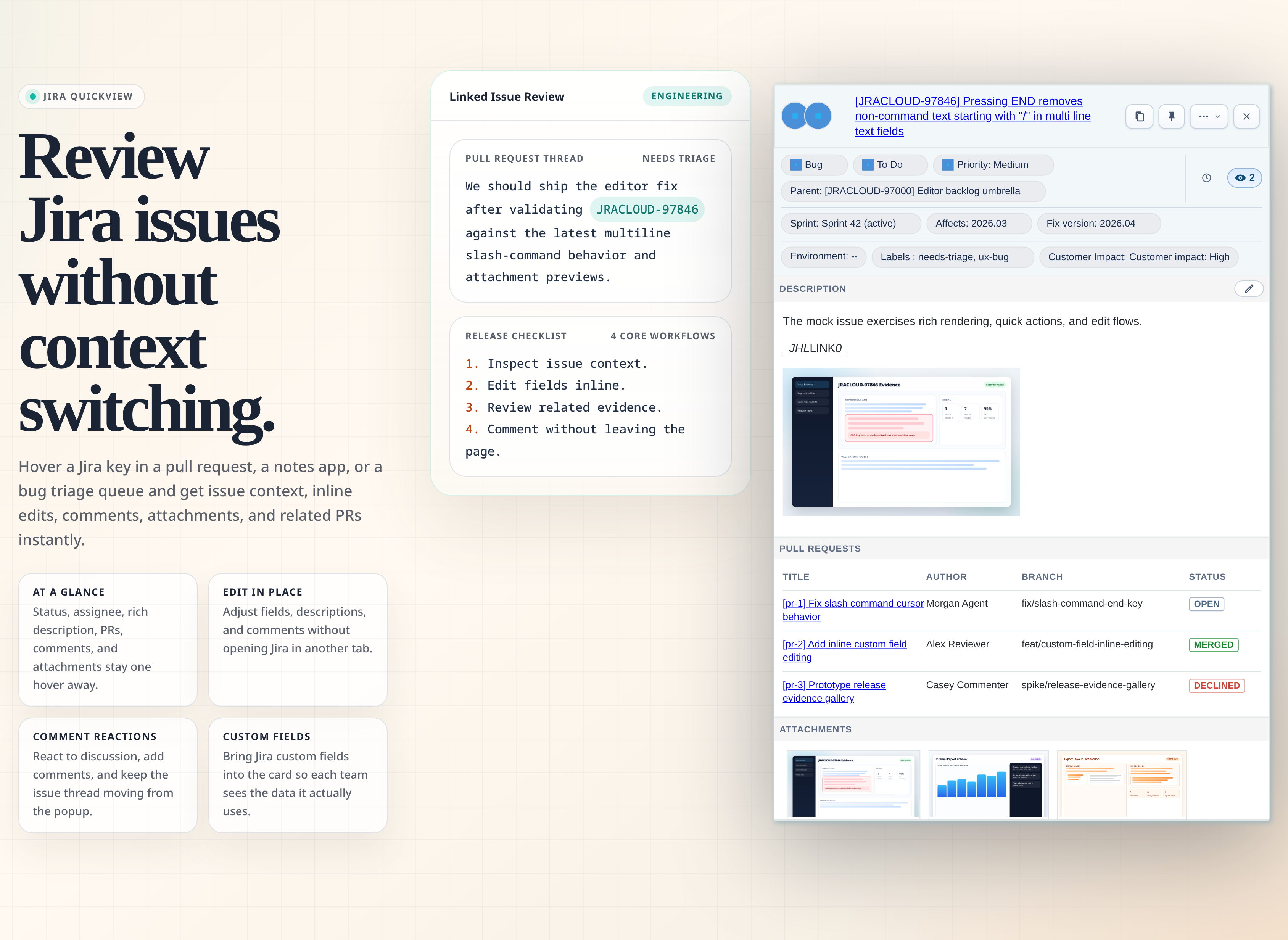
Jira QuickView is built for people who see Jira issue keys outside Jira all day: in Gmail, Outlook, GitHub, release notes, incident docs, QA checklists, internal dashboards, and team wikis.
With the extension, you can:
- Open a Jira issue in QuickView from its link, with optional hover preview for recognized keys such as
ABC-123. - Copy issue links beside recognized Jira references in Jira and on allowed pages.
- See the issue summary, reporter, assignee, status, priority, versions, sprint, labels, linked Jira issues, description, comments, attachments, history, and linked pull requests.
- Update supported fields directly from the popup when Jira allows it.
- Add comments, mention teammates, react to comments, edit your own comments, and inspect attachment evidence.
- Customize which fields and content blocks appear in the popup.
2. Before You Start
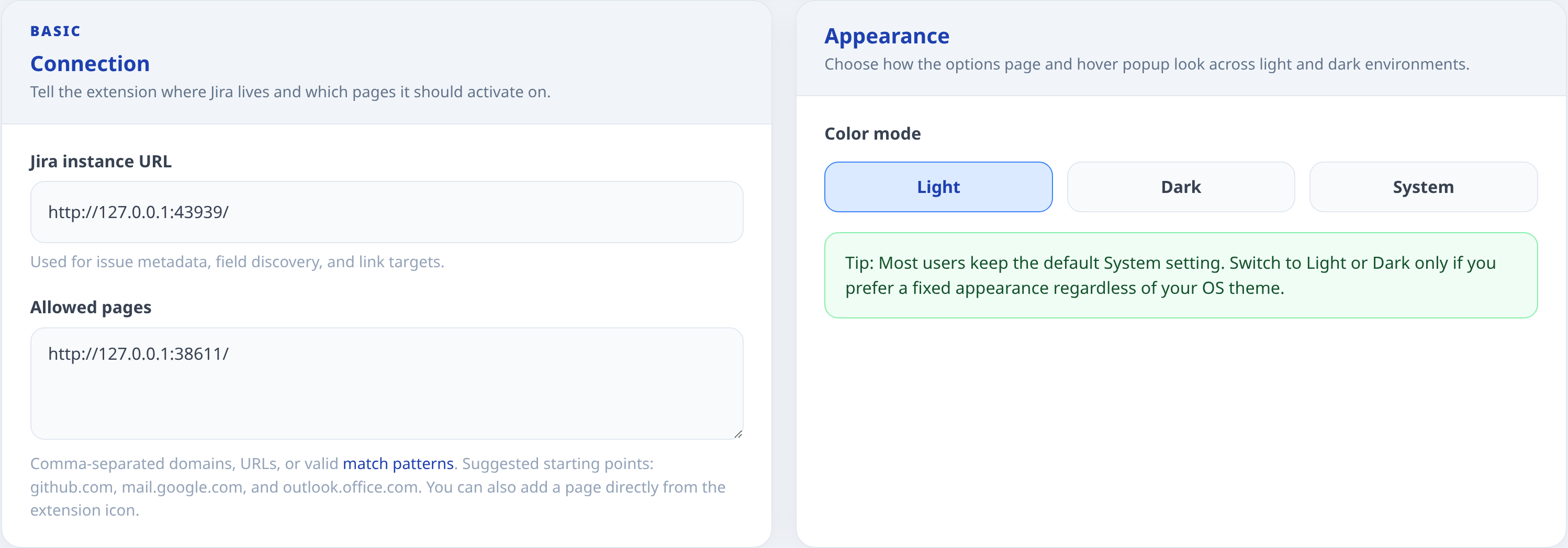
Before Jira QuickView can show issue data, these things must be true:
- Jira QuickView must be installed from the Chrome Web Store: Download Extension.
- Best support today is on desktop Chromium browsers such as Chrome, Edge, and Brave.
- You must be signed in to Jira in the same browser.
- The extension must know your Jira instance URL.
- The page where you want popups must be allowed in the Options page.
Jira QuickView uses your existing browser session. It does not store a separate Jira password. If your Jira instance requires VPN or company network access, the extension has the same requirement because the requests are still going from your browser to Jira.
3. First-Time Setup
- Install Jira QuickView from the Chrome Web Store: Download Extension.
- Open the Jira QuickView Options page.
- Enter your Jira instance URL, for example
https://your-company.atlassian.net. - Add the pages where you want Jira issue popups to appear.
- Choose your color mode, or keep
System. - Click
Save. - Open an allowed page and click a Jira issue link.
If nothing happens after setup, check the troubleshooting section at the end of this guide. The most common causes are an unallowed page, a Jira URL typo, not being signed in to Jira, or disabling both click interception and hover preview.
3.1 Use websites as desktop apps (PWAs)
This subsection is only about turning supported websites such as Gmail or Outlook on the web into standalone desktop-style app windows after Jira QuickView already works in your browser.
Before installing a site as a desktop app:
- Install Jira QuickView in a supported desktop browser:
Chrome,Microsoft Edge, orBrave. - Open Jira QuickView Options and configure your Jira URL plus allowed pages.
- Open the target site in a normal browser tab first and confirm that clicking a Jira issue link opens QuickView there.
- Make sure the exact site domain is in
Allowed pages.
Useful allowed page examples:
mail.google.comoutlook.office.comoutlook.office365.comoutlook.live.com
Chrome
- Open the site you want to use as a desktop app, such as Gmail or Outlook on the web, in Chrome.
- Click the Chrome menu (
⋮) in the top-right corner. - Choose
Cast, save, and share. - Click
Install page as app.... - Confirm by clicking
Install. - Launch the installed app from your desktop, taskbar, Start menu, or app launcher.
- Open a message or page that contains a Jira key and confirm Jira QuickView still works inside the app window.
If Chrome shows an install icon in the address bar for that site, you can click that icon instead of opening the menu.
Microsoft Edge
- Open the site you want to use as a desktop app, such as Outlook on the web, in Edge.
- Click
Settings and more(...) in the top-right corner. - Choose
More tools. - Choose
Apps. - Click
Install this site as an app. - Confirm the install dialog.
- Launch the installed app window and verify Jira QuickView works there.
You can later manage or reopen installed sites at edge://apps.
Brave
- Open the site you want to use as a desktop app in Brave.
- First look for an install icon in the address bar and click it if Brave shows one.
- If there is no address-bar install icon, open the Brave menu.
- Use Brave's install or app-window command for the current site.
- If your Brave build does not show a direct install command, use the site shortcut flow and enable
Open as windowif Brave offers it. - Launch the installed app window and verify Jira QuickView works there.
Brave is Chromium-based, so the overall flow is similar to Chrome, but exact menu wording can vary by Brave version.
Pin the installed app for quick access
Windows
- Launch the installed web app once so Windows registers it clearly in Start and on the taskbar.
- To pin it to the taskbar, right-click the running app icon on the taskbar and choose
Pin to taskbar. - To pin it to Start, open
Start, find the installed app, right-click it, and choosePin to Startif Windows shows that option.
Mac
- Launch the installed web app.
- In the Dock, Control-click or right-click the app icon.
- Choose
Options>Keep in Dock.
Linux
- Launch the installed web app.
- In your desktop app menu, dock, or panel, find the app icon.
- Right-click it and choose the pinning option your desktop environment uses, such as
Add to Favorites,Pin to Dash, orPin to Panel.
Linux desktop labels vary by environment, but the installed app normally appears like any other desktop app after installation.
What a PWA is and what it enables
A PWA, or installed website app, is a normal website opened in its own desktop-style window instead of a regular browser tab.
For Gmail, Outlook, GitHub, or similar sites, this usually gives you:
- a separate taskbar or dock icon
- a dedicated launcher or Start-menu entry
- a cleaner app-style window without your normal tab strip
- the same browser profile, cookies, extensions, and Jira session you already use in the browser
For Jira QuickView specifically, the main benefit is that web apps such as Gmail or Outlook can feel closer to native desktop apps while still keeping the extension available.
4. Options Page
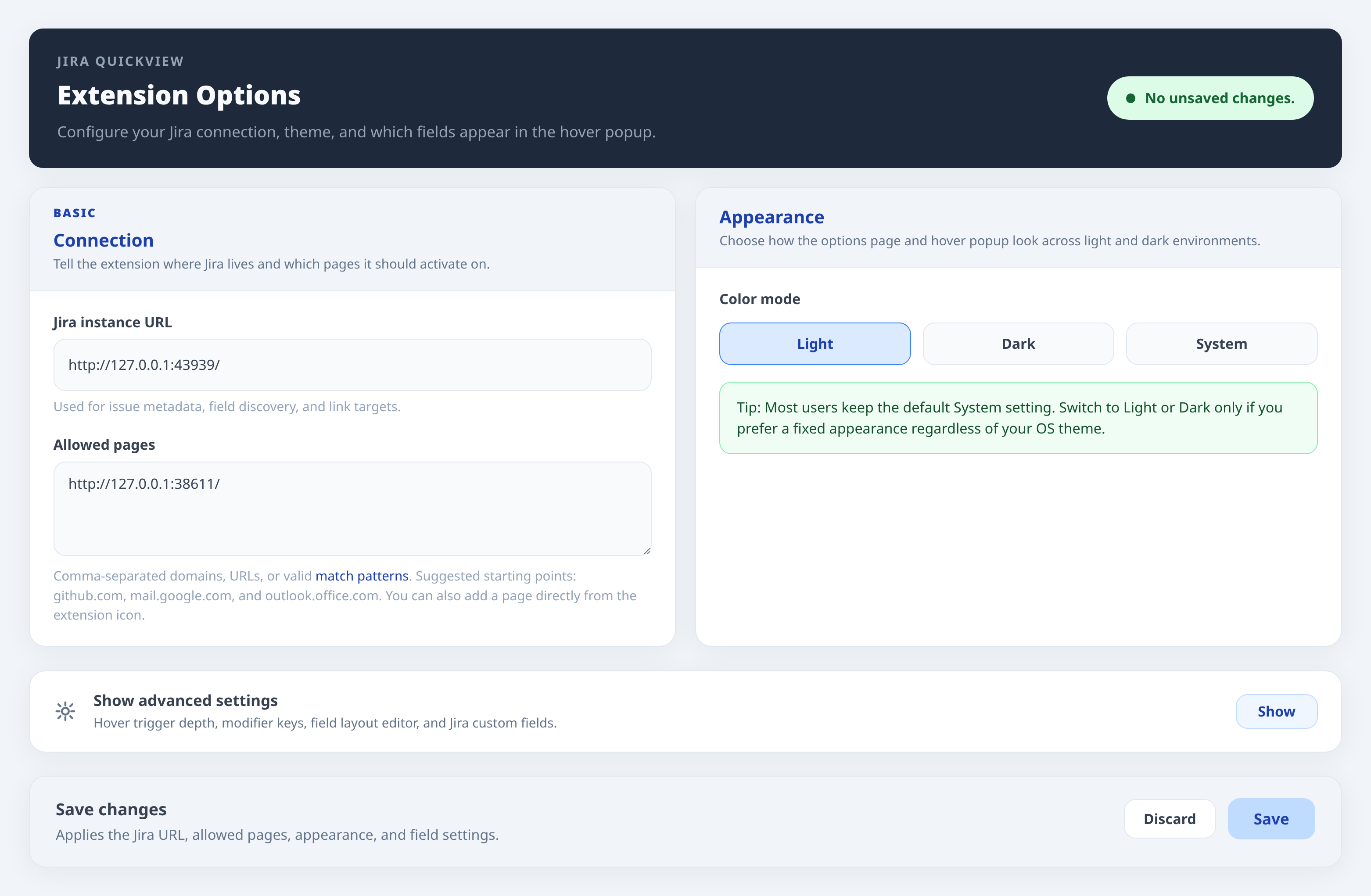
The Options page controls where Jira QuickView runs and what the popup shows. Most users only need the Basic settings. Advanced settings are useful when you want tighter hover behavior, a team-specific popup layout, custom Jira fields, or a shared configuration file.
4.1 Basic: Connection
The Connection block tells Jira QuickView which Jira site to use and which websites can show the popup.
Jira instance URL
Enter the normal Jira address you use in the browser. Examples:
https://your-company.atlassian.nethttps://jira.your-company.com
If you omit https://, Jira QuickView normalizes the value for you when possible. Still, the clearest setup is to paste the full address from your browser.
Allowed pages
Allowed pages decide where Jira QuickView is allowed to inject its popup. This protects you from having the extension run everywhere.
Simple examples:
github.commail.google.comoutlook.office.comdocs.your-company.com
Advanced examples:
https://github.com/your-org/*https://*.your-company.com/*https://wiki.your-company.com/projects/*<all_urls>
Technical note: this field accepts comma-separated domains, full URLs, Chrome-style match patterns, and wildcard patterns using *. Internally, Jira QuickView normalizes these patterns and converts wildcards into regular-expression matching. It does not treat the field as arbitrary raw JavaScript regex syntax, so prefer * wildcards instead of writing regex metacharacters directly.
What to know:
- A simple domain such as
github.combecomes a broad match for that domain. - A full URL with a path can limit matching to that part of a site.
- Wildcards are useful for subdomains, for example
https://*.your-company.com/*. - The extension also asks Chrome for host permissions when you save. If you cancel the browser permission prompt, the settings may not apply.
- If this is your first save and no Jira URL was stored before, Jira QuickView also adds your Jira instance URL to the allowed pages list.
4.2 Basic: Appearance
The Appearance block controls the color mode for the Options page and popup, as well as whether Jira QuickView adds copy actions inside Jira.
Available modes:
Systemfollows your operating system or browser preference.Lightkeeps the extension in light mode.Darkkeeps the extension in dark mode.
Most users should keep System. Use Light or Dark only if you want Jira QuickView to stay fixed regardless of your OS theme.
Show copy buttons beside Jira issues is enabled by default. It adds copy actions in Jira and beside Jira links and plain issue IDs on allowed pages. Issue titles are fetched only when needed for copying. Editable text and action controls are excluded.
Open Jira issue links in QuickView instead of navigating is also enabled by default. A plain left click on a genuine Jira issue link opens and pins QuickView instead of leaving the page. Turn it off to preserve normal link navigation. Middle-click and modifier-click always keep native browser behavior.
4.3 Advanced: Show Advanced Settings

The Advanced section is hidden by default so the setup page stays simple. Open it when you want to change how the popup is triggered, how its rows are arranged, which custom fields appear, or how to export/import settings.
Advanced settings are still safe to use, but they affect the day-to-day feel of the extension. If you are setting this up for a team, configure one browser first, test the popup on real work pages, then export the configuration for others.
4.4 Advanced: Hover Preview
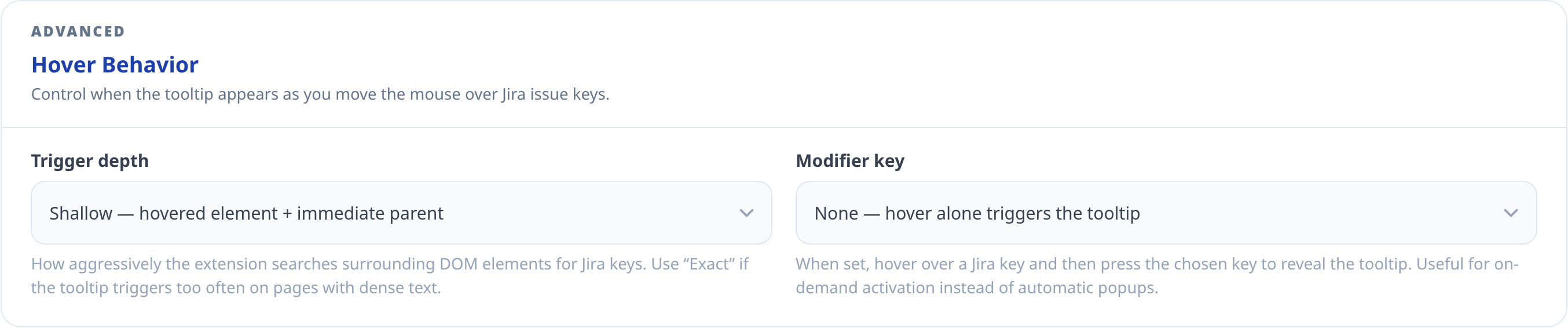
Hover preview has three modes:
Offdisables hover preview.Automaticpreviews an issue when you hover a recognized Jira key. This is the default.With modifierpreviews only while the selected modifier key is pressed.
Depth
Depth controls how aggressively hover preview searches surrounding page elements for Jira keys. It is disabled when Hover preview is Off.
Exactchecks only the exact element under your mouse.Shallowchecks the hovered element and its immediate parent.Deepwalks up to 5 ancestor levels and is the most sensitive.
Use Exact if popups appear too often on dense pages. Use Deep if a site wraps issue keys in complex HTML and the popup does not reliably open.
Modifier key
Modifier key is available only when Hover preview is set to With modifier.
Altopens it when you hover and then pressAlt.Ctrlopens it when you hover and then pressCtrl.Shiftopens it when you hover and then pressShift.Anyopens it when you hover and then pressAlt,Ctrl, orShift.
Modifier keys are useful on pages with many Jira keys, such as inboxes and pull request pages. They prevent accidental previews while still keeping the issue one gesture away.
4.5 Advanced: Tooltip Layout Overview
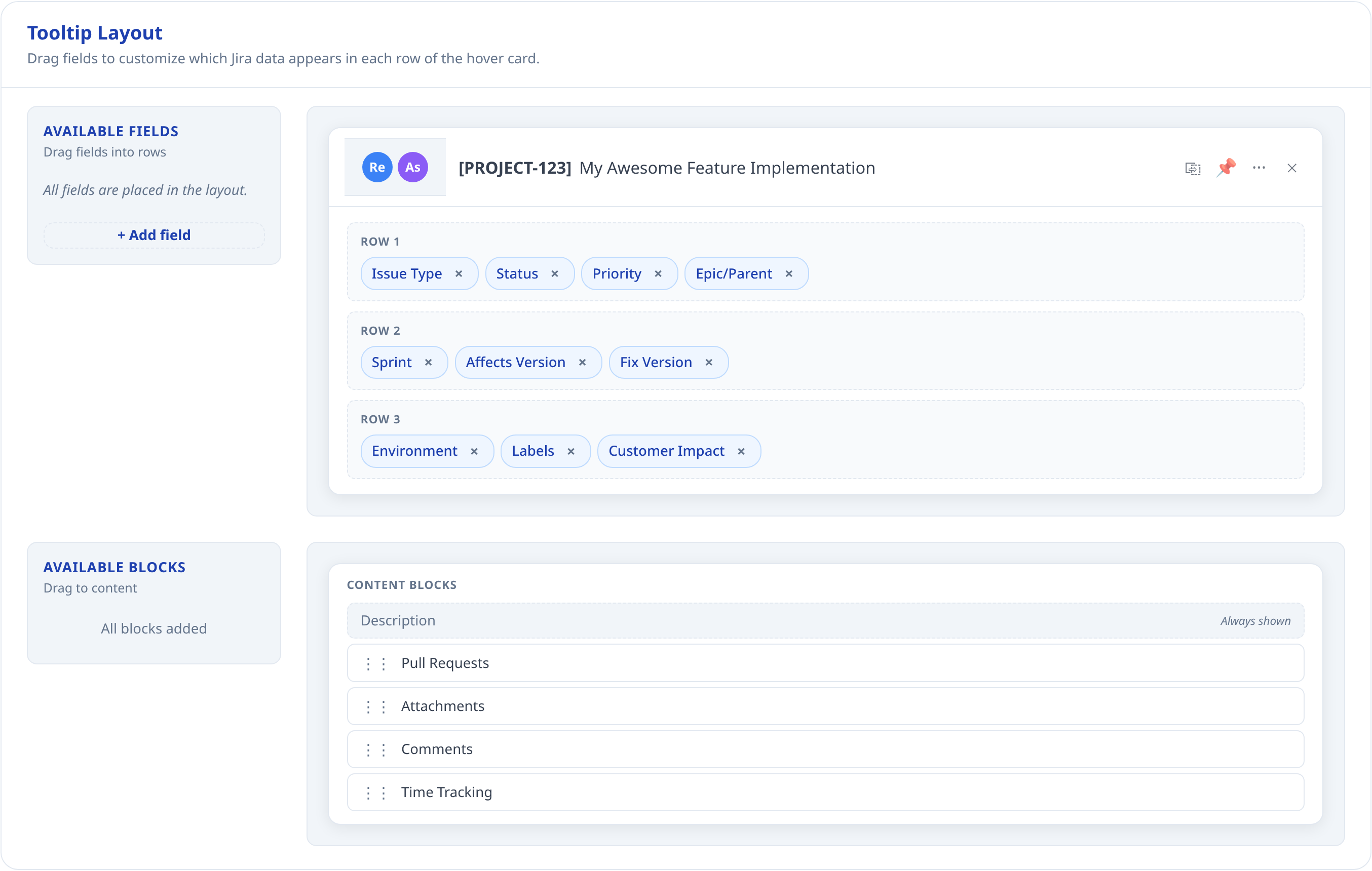
Tooltip Layout controls the rows and content blocks inside the popup. The layout editor has two concepts:
- Fields are small chips placed in Row 1, Row 2, or Row 3.
- Content blocks are larger sections below the rows, such as Description, Pull Requests, Comments, Attachments, and Time Tracking.
The preview in the Options page shows the overall shape of the popup. It is not a live Jira issue. It helps you understand where fields will appear after saving.
What to know:
- Drag fields from
Available Fieldsinto Row 1, Row 2, or Row 3. - Drag content blocks into the content area to show them in the popup.
- Remove a field or block if it is not useful for your team.
- Description is treated as the core issue content and is always represented in the content area by the current layout editor.
- Reporter, assignee, summary, copy, pin, quick actions, and close live in the popup header. They are explained in the popup section of this guide.
4.6 Advanced: Organizing Row Fields
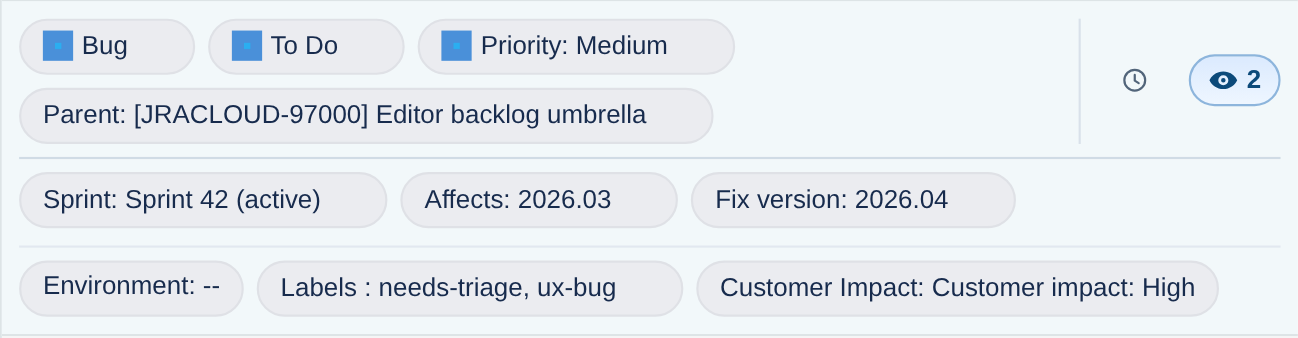
The three popup rows are for compact issue facts. Use them to decide what a user should understand before reading the larger content blocks.
Suggested organization:
- Row 1 is for urgent triage data, such as Issue Type, Status, Priority, Linked Issues, History, and Watchers.
- Row 2 is for planning and release data, such as Epic or Parent, Sprint, Affects Version, and Fix Version.
- Row 3 is for supporting context, such as Environment, Labels, and custom fields you add.
Good layouts keep the first row short and high-signal. If a field is useful only after initial triage, put it in Row 2 or Row 3. If a field is rarely used, remove it from the popup entirely or keep it in Jira.
Business logic and limitations:
- Issue type editing appears only when Jira says the field is editable and there is more than one valid issue type available.
- Status editing shows Jira workflow transitions, not every status in the project.
- Priority editing appears only when Jira exposes priority as editable for that issue.
- Epic/Parent depends on whether the issue uses Jira parent hierarchy or an Epic Link style field.
- Sprint support depends on Jira Agile fields being visible to the extension.
- Sprint editing appears only if Jira exposes a valid Sprint field and editable metadata for the issue.
- Version chips can link to Jira filters when there is exactly one version value. When multiple versions are present, the chip is still informative but may not be linked as narrowly.
- Environment editing appears only when Jira allows the
setoperation for that field. - Labels editing requires both Jira edit permission and label suggestion support.
- Custom fields can be displayed even when they cannot be edited.
- Long text in chips can be truncated to keep the popup usable.
- Row chips can link to filtered Jira searches when the field value can be expressed as a useful JQL filter.
4.6.1 Custom Fields
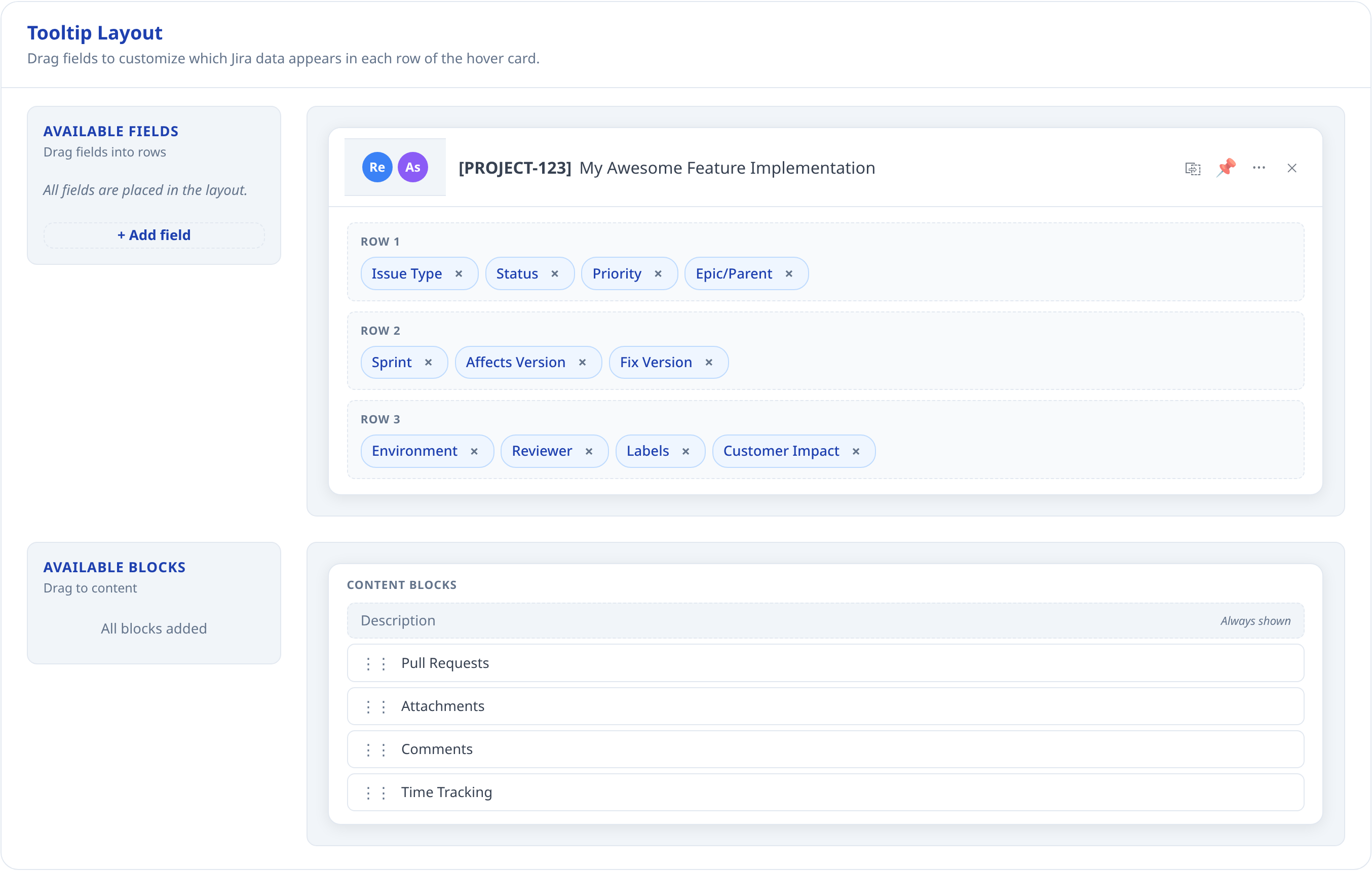
Custom fields let you add team-specific Jira fields to Row 1, Row 2, or Row 3. This is useful for fields like Customer Impact, Reviewer, Tempo Account, Severity, Component Owner, Release Train, or any other Jira field your team relies on.
How to add a custom field:
- Open Advanced settings.
- In Tooltip Layout, click
+ Add field. - Enter the Jira field ID, for example
customfield_12345. - Wait for Jira QuickView to validate the field name.
- Save it and drag it into the row where you want it.
- Click
Saveat the bottom of the Options page.
What to know:
- Jira field IDs are not always the same as field names. A field named
Customer Impactmight have an ID likecustomfield_12345. - Jira QuickView validates custom fields by reading Jira's field catalog.
- Built-in fields such as
status,priority,assignee, anddescriptioncannot be added again as custom fields. - A custom field can be visible but not editable.
Custom field editing support:
- User fields and multi-user fields can use user search when Jira allows editing.
- Tempo Account fields can use account search when Jira exposes the right field metadata.
- Single-select and multi-select custom fields can be edited when Jira provides allowed values and the
setoperation. - Simple single-value text-like fields can be edited as text or textarea when supported.
- Unsupported or permission-blocked fields are displayed as read-only chips.
4.7 Advanced: Content Blocks
Content blocks are larger sections under the popup rows. They are where you read and work with issue content.
Available blocks:
- Description
- Attachments
- Comments
- Pull Requests
- Time Tracking
How to use them:
- Keep blocks you use every day near the top.
- Remove blocks that create noise for your team.
- If your team mostly triages from email, Description and Comments are usually the most important.
- If your team reviews releases, Pull Requests, Attachments, and History are often more important.
Business logic and limitations:
- Image attachments use previews when Jira supplies usable media data. Non-image files appear as compact entries with a type, size when available, and a link to the original file.
- Pull Requests appear only when Jira returns development-status data for the issue.
- Time Tracking appears when Jira exposes time tracking data or editable time tracking metadata.
- Comments appear when the content block is enabled. The composer follows your Jira permissions.
4.8 Advanced: Settings Sync


Settings Sync lets you move a Jira QuickView configuration between browsers or teammates.
Available actions:
Export (.json)downloads the current configuration as a versioned JSON file.Import (.json)loads a previously exported file or Team Sync settings file into the Options page.- The global
Savebutton stores the Team Sync source in this browser and runs the first sync check. Sync Nowruns a one-off sync against the current Team Sync fields without saving that source in the browser.Disconnectremoves the saved Team Sync source from this browser.
Team Sync sources:
Jira attachment: point the extension at one Jira issue key and one attachment filename.Settings file URL: point the extension at one HTTPS or HTTP URL that serves the JSON file.
What goes in the shared file:
- Team Sync reads a versioned JSON document like jira-quickview-settings.json.
- The file must include
schemaVersion, a top-levelsettingsRevisionnumber such as1,2, or3, and asettingsobject. - The current
Export (.json)output already uses the Team Sync file format, so it is a good starting point for administrators publishing a shared file. - The Team Sync source itself is still stored locally in the browser, not inside the shared settings file. Importing a file does not automatically connect the browser to a shared Jira issue or URL.
First-time setup for end users:
- Open the extension Options page.
- If your team uses
Jira attachment, save your Jira instance URL first. - Open
Advancedand findTeam Sync. - Choose
Jira attachmentorSettings file URL. - Enter the shared Jira issue key and filename, or paste the shared URL.
- Click the global
Savebutton and accept the permission prompt if Chrome asks for it. Jira QuickView saves the Team Sync source in this browser and immediately runs the first sync check.
What users need from an administrator:
- For
Jira attachment: the Jira issue key and the exact attachment filename. - For
Settings file URL: the direct URL to the JSON file.
Publishing updates:
- Keep the shared location stable. For Jira attachment mode, keep the attachment filename stable. For URL mode, keep the shared URL stable.
- Publish a new JSON file with a higher
settingsRevision. - For Jira attachment sync, upload the new file to the same issue with the same filename. Jira QuickView picks the newest matching attachment automatically, including Jira's duplicate-upload rename pattern.
- A sample file is available at jira-quickview-settings.json.
Failure handling:
- If the source URL is wrong, the Jira issue key is invalid, the attachment is missing, or the JSON is invalid, the Team Sync panel shows an error.
- The last successfully applied team configuration stays active.
- When a later sync succeeds, the extension applies the newer revision automatically.
Important:
- Importing settings does not fully apply them until you click
Save. This gives you a chance to review the Jira URL, allowed pages, layout, hover behavior, and custom fields before changing the active browser setup. Savestill succeeds even if the first Team Sync fetch fails. Your local settings and Team Sync source are saved, the last good synced team configuration stays active, and the sync error remains visible in the Team Sync panel.
4.9 Save and Discard

The footer of the Options page applies or discards changes.
Savewrites the configuration to Chrome storage, requests any needed host permissions, refreshes the extension's page matching rules, and runs the first Team Sync check when Team Sync is configured.Discardreloads the Options page and drops unsaved changes.- The status pill at the top of the page tells you whether there are unsaved changes or whether the current form matches the last saved state.
- Save notices in the footer report the save result. Team Sync errors stay in the Team Sync panel itself.
If custom fields are invalid, saving is disabled until the issue is fixed. This prevents a broken field ID from being saved accidentally.
5. Using the Popup Every Day
After setup, the normal flow is simple:
- Open a page you allowed in Options.
- Plain-click a genuine Jira issue link to open and pin QuickView without navigating away.
- For a Jira ID that is not a link, hover it to open the automatic preview.
- If Hover preview is set to
With modifier, press the configured key after hovering. - Read or update the issue from QuickView.
The popup uses your Jira permissions. If you can only view an issue in Jira, the popup will mostly be read-only. If you can edit the issue in Jira, supported edit controls may appear.
5.1 Where the Popup Appears
The popup appears on pages matched by your Allowed pages settings. Common places include:
- Jira notification emails in Gmail or Outlook on the web
- GitHub pull requests, issues, commits, and release notes
- Internal docs and wiki pages
- QA checklists
- Incident notes
- Release dashboards
The extension only looks for Jira issue keys on allowed pages. It does not scan every site you visit.
5.1.1 Copy Issue Links Inside Jira
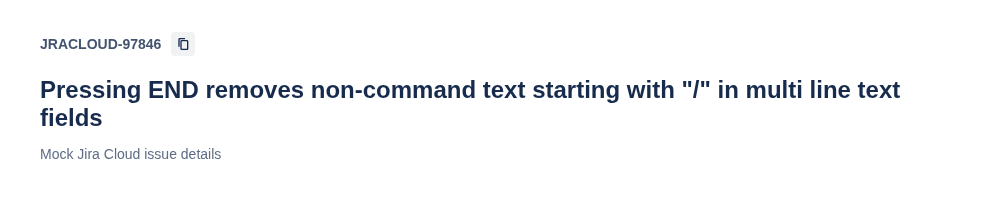
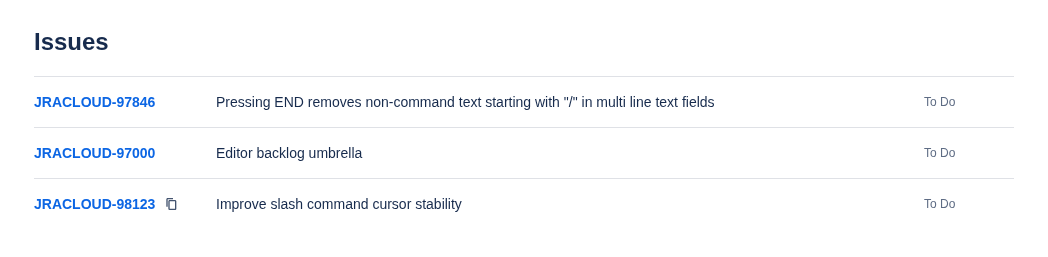
When Show copy buttons beside Jira issues is enabled, Jira QuickView adds copy actions inside Jira and beside recognized Jira links and plain issue IDs on allowed pages.
| Issue details | Search results | Board cards |
|---|---|---|
 |
 |
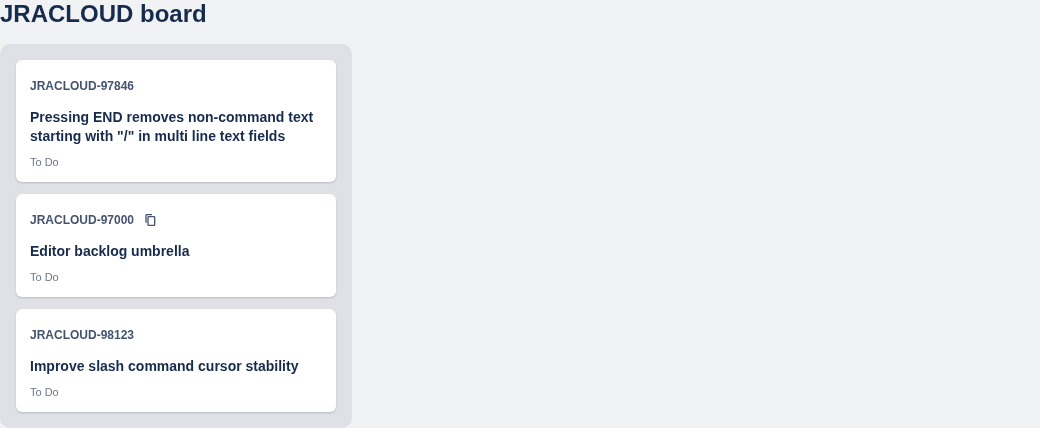 |
The action is always available beside the key on issue details. In search results, boards, and backlogs, hover or focus a result to reveal it without adding permanent visual clutter.
Copying uses the same behavior as the popup header: applications that accept rich clipboard content receive a linked [KEY] Summary label, while the plain-text clipboard contains the canonical Jira issue URL. Jira QuickView follows dynamically loaded Jira content and avoids adding duplicate actions during in-app navigation.
If the copy action is missing, confirm that Show copy buttons beside Jira issues is enabled and the page is allowed (or belongs to your configured Jira instance), save Options, and reload the tab.
5.2 Header: Reporter, Assignee, Summary, and Actions
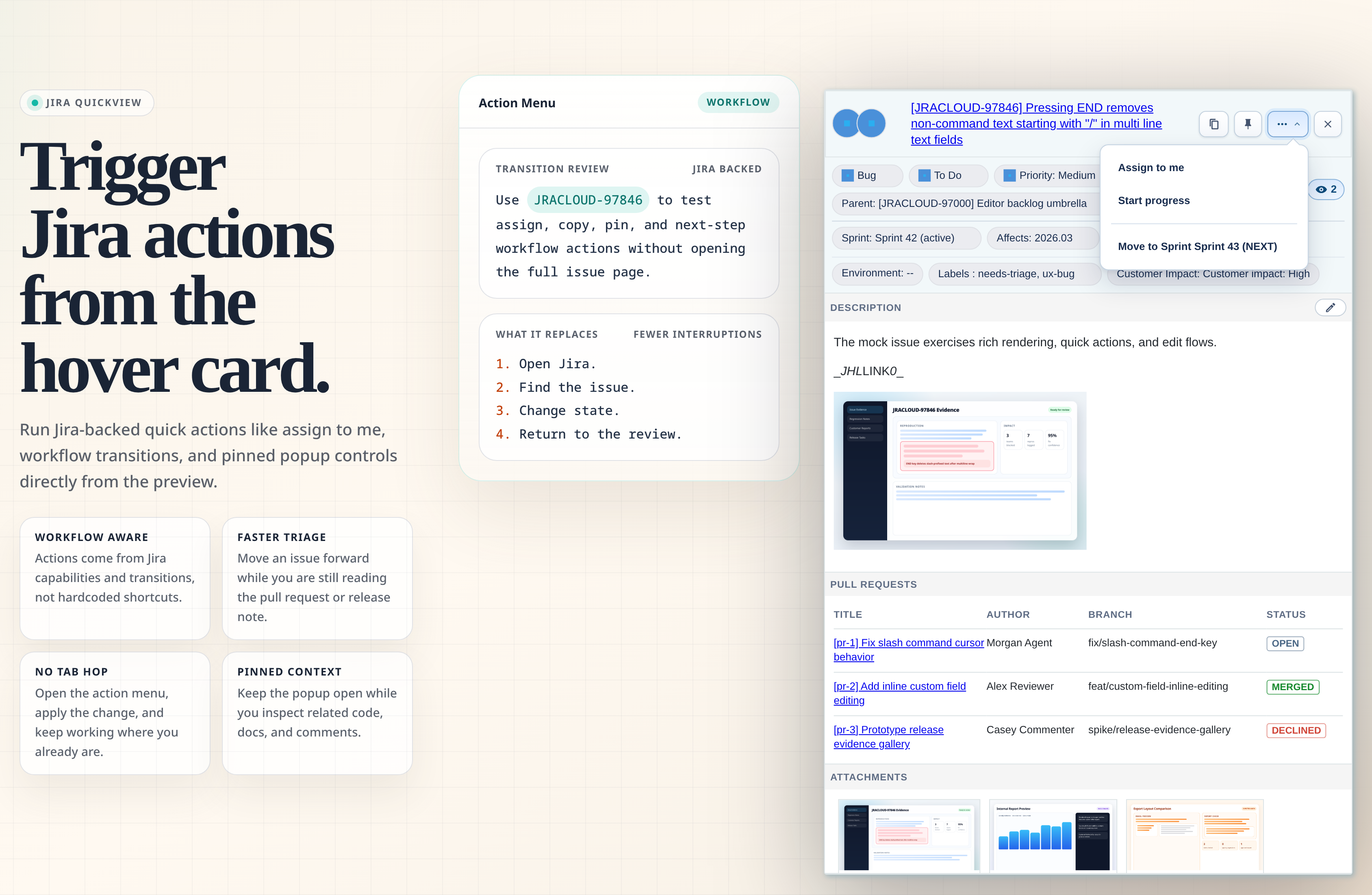
The header is the top part of the popup. It keeps the most common actions close together.
Header items:
- Reporter avatar shows who reported the issue.
- Assignee avatar shows who owns the issue. If Jira allows editing, you can click the edit control and search assignable users.
- Summary link opens the full Jira issue in a new tab.
- Summary edit lets you rename the issue when Jira allows the
summaryfield to be changed. - Copy copies the issue link.
- Pin keeps the popup open while you move the mouse.
- Quick actions opens Jira-backed shortcuts.
- Close hides the popup.
Escalso closes it.
Business logic and limitations:
- Assignee search uses Jira assignable-user logic for the specific issue, so it should match who can actually be assigned.
- Summary editing appears only when Jira edit metadata says the summary field supports
set. - Quick actions appear only when at least one action is available.
5.3 Quick Actions Menu
Quick actions are shortcuts for common Jira updates.
Examples:
- Assign the issue to yourself.
- Move the issue to the next useful workflow state, such as starting progress.
- Move the issue to an active or upcoming sprint when Jira exposes a valid sprint field.
Business logic and limitations:
- Quick actions are not hardcoded guesses. They are built from the current issue, current user, Jira transitions, and available sprint data.
Assign to meappears only when the current assignee is not already you and Jira can resolve your user identity.- Start-progress style actions appear only when Jira exposes a matching transition.
- Sprint actions appear only when Jira exposes a sprint field and available active or future sprints.
5.4 Row 1: Issue Type, Status, Priority, Linked Issues, History, and Watchers
Row 1 is the fastest read of the issue.
Default fields:
- Issue Type tells you whether this is a bug, task, story, sub-task, or another Jira type.
- Status tells you the current workflow state.
- Priority tells you the urgency or importance set in Jira.
- Linked Issues shows how many children, linked issues, and external links the current ticket has, and opens the Children and Links panel.
- History opens a timeline of issue changes.
- Watchers shows how many people watch the issue and whether you are watching.
Business logic and limitations:
- Status edit options are Jira transitions from the current state, not a list of every possible project status.
- Linked-issue actions follow Jira's issue-link permissions and configured link types.
- The Watchers count comes from Jira's watcher data.
- History data loads only when you open the history panel, which keeps the initial popup faster.
5.4.1 Children and Links Panel
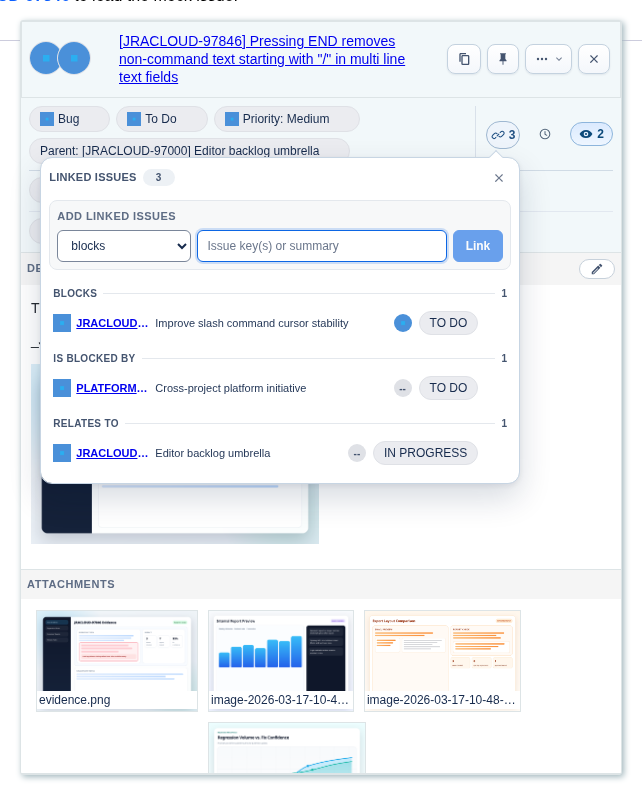
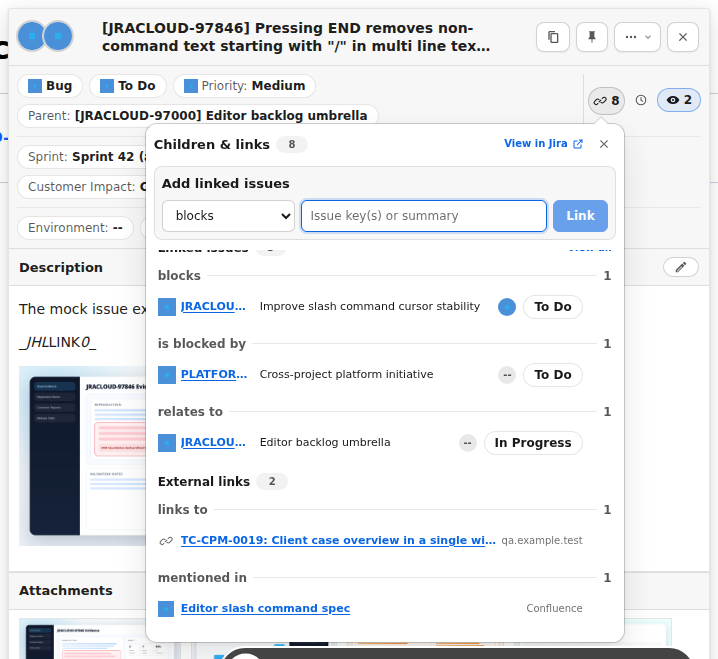
The Children and Links panel shows everything attached to the issue without leaving the page, in three sections:
- Children: sub-tasks and other child issues, such as the issues in an epic. Children are shown for reference and cannot be removed here.
- Linked issues: Jira issue links, grouped by their displayed relationship, such as
blocks,is blocked by, orrelates to. - External links: links to pages outside Jira, such as test cases or Confluence pages, grouped by relationship, such as
links toormentioned in.
Sections with nothing in them are hidden. View in Jira in the panel header opens the issue's links in Jira, and View all beside Children or Linked issues opens that list as a Jira search.
Each child and linked issue row includes:
- Issue type and key
- Summary
- Current status
- Assignee avatar, with the full assignee name on hover
- For linked issues, a remove action that appears on hover and asks for confirmation before deleting the link
Each external link row shows the link title, which opens the page in a new tab, and the site or application it points to. External links can be removed the same way as linked issues.
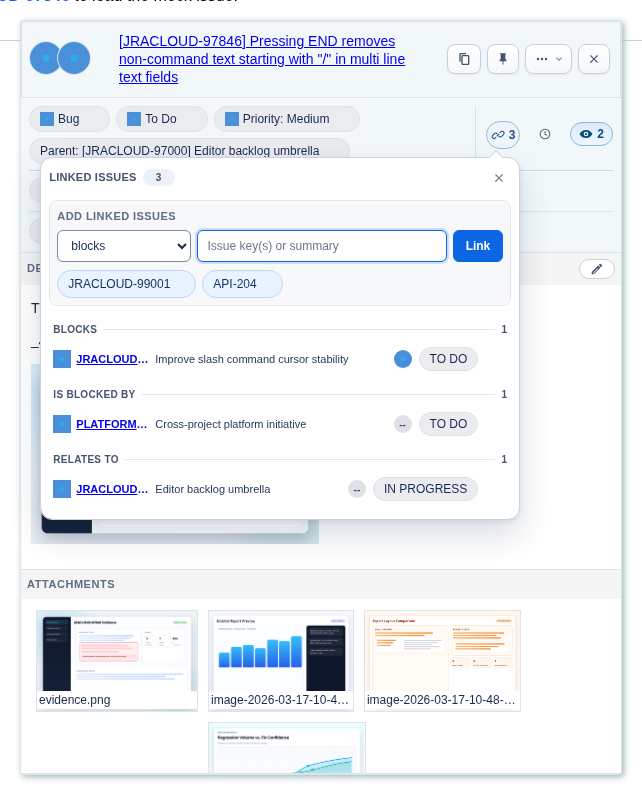
To add linked issues:
- Choose the relationship from the dropdown.
- Search by Jira key or summary. Results from the current project are sorted first.
- Select one or more autocomplete results, or enter multiple Jira keys separated by commas, spaces, or new lines.
- Review the selected key chips and click
Link.
Business logic and limitations:
- Jira controls which relationship types are available and whether you can create or delete links.
- The panel adds issue links only. Create sub-tasks and external links in Jira.
- A multi-link request may partially succeed. Successful links are refreshed immediately, while failed keys stay selected with an inline error so you can retry.
- Exact Jira keys can be entered directly. Autocomplete depends on Jira's issue-picker or search APIs.
- Opening Linked Issues closes History or Watchers if either panel is open.
5.4.2 History Panel
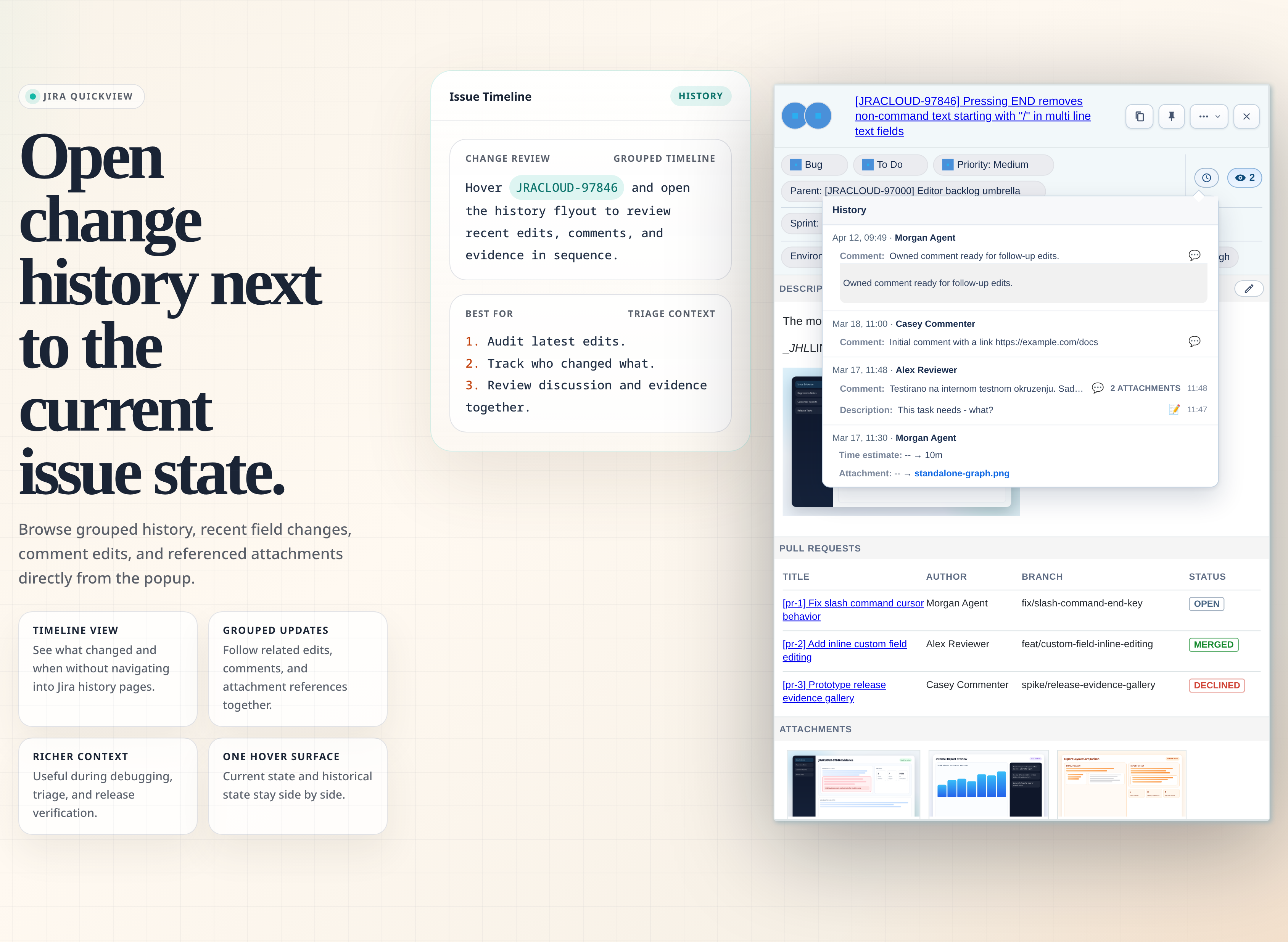
The History panel shows recent issue changes without opening Jira's full history page.
What you can see:
- Who changed the issue
- When the change happened
- Field changes, such as status, assignee, labels, versions, or custom fields
- Rich description or comment changes when available
- Attachment references connected to history entries
Business logic and limitations:
- Jira QuickView formats Jira changelog data into grouped entries.
- Rich text history may be summarized first, with expandable details for longer content.
- History is a view of Jira's recorded changelog. If Jira does not record a detail, Jira QuickView cannot invent it.
- Opening History closes Linked Issues or Watchers if either panel is open, so the popup stays readable.
5.4.3 Watchers Panel
The Watchers control shows how many people are watching the issue. Clicking it opens the Watchers panel.
What you can do:
- See who is watching the issue.
- Search for users to add as watchers.
- Remove watchers when Jira allows it.
- See whether you are currently watching the issue.
Business logic and limitations:
- Watcher search uses Jira user search and filters out people who are already watching.
- Add and remove actions use Jira's watcher APIs and your Jira permissions.
- If Jira blocks adding or removing a watcher, the panel shows an error and keeps the current list usable.
- Opening Watchers closes Linked Issues or History if either panel is open.
5.5 Row 2: Epic, Parent, Sprint, Affects Version, and Fix Version
Row 2 is usually where planning and release information lives.
Common fields:
- Epic or Parent links the issue to larger work.
- Sprint shows the sprint or sprints associated with the issue.
- Affects Version shows where the problem or request applies.
- Fix Version shows the planned or delivered release.
Business logic and limitations:
- Parent editing depends on the hierarchy model Jira exposes for the issue.
- Sprint values can come from Jira Agile fields that vary by company and project.
- Version chips are most linkable when there is exactly one version.
- Picker and multi-value edits save when you click elsewhere in QuickView or outside it.
Escapecancels;Enteraccepts the highlighted single-value option, andCtrl+EnterorCommand+Entersaves multi-value changes. - Fix Version and Affects Version choices list unreleased versions first, followed by the five most recent released versions.
- These fields can be moved to other rows in the layout editor if your team wants a different visual priority.
5.6 Row 3: Environment, Labels, and Custom Fields
Row 3 is good for context fields that are useful but usually less urgent than status or priority.
Common fields:
- Environment shows deployment, browser, device, customer, or test environment notes.
- Labels show Jira labels and can link to label-filtered Jira searches.
- Custom fields show team-specific data that you added in Options.
Business logic and limitations:
- Environment can be edited only when Jira says it is editable with the
setoperation. - Labels can be edited only when Jira allows label updates and label suggestions are supported.
- Custom fields may show read-only values if their type is unsupported or Jira does not allow editing.
5.7 Description Block
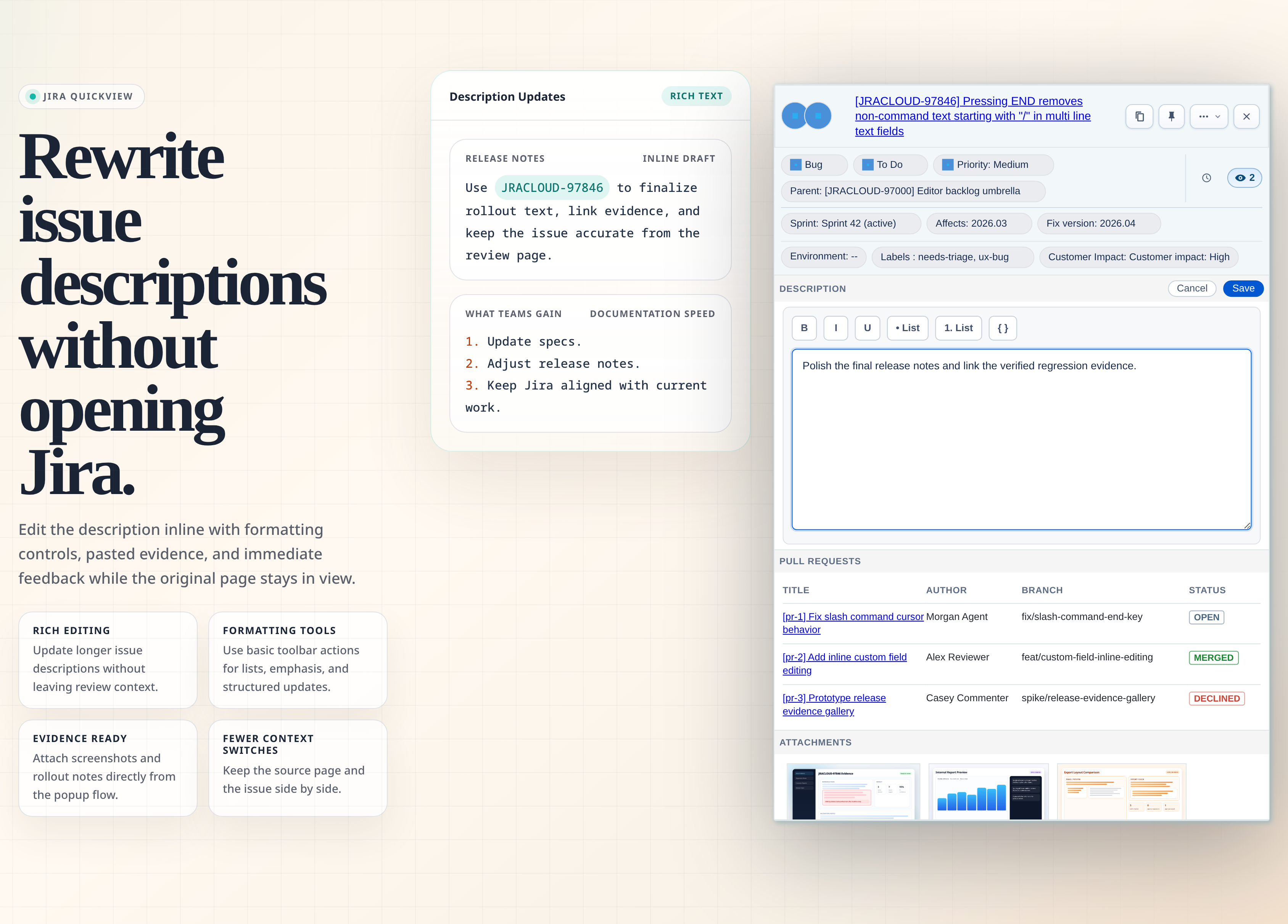
The Description block shows the issue description. If Jira allows it, you can edit it directly in the popup.
What you can do:
- Read formatted issue details.
- Edit or add a description.
- Use simple formatting controls for bold, italic, underline, lists, and code blocks.
- Paste or attach images while editing.
Business logic and limitations:
- The edit button appears only when Jira says the description field supports the
setoperation. - Save is disabled until something changes or uploads finish.
- If you close or switch issues while editing, draft attachment cleanup may run so abandoned uploads do not linger.
- Jira formatting support depends on how your Jira instance stores description content.
5.8 Time Tracking Block
The Time Tracking block lets you view estimates and log work from the popup when Jira exposes time tracking.
What you can do:
- View original estimate.
- View remaining estimate.
- View time spent.
- Log new work with amount, description, and date.
- Edit estimates when Jira allows it.
Business logic and limitations:
- Estimate inputs are disabled if Jira does not allow editing estimates on the current issue.
- Logging work can still be available even when estimate editing is not.
- Save is disabled until you change something.
- Accepted time formats depend on Jira, but common examples include values like
30m,1h, or2h 30m.
5.9 Attachments Block
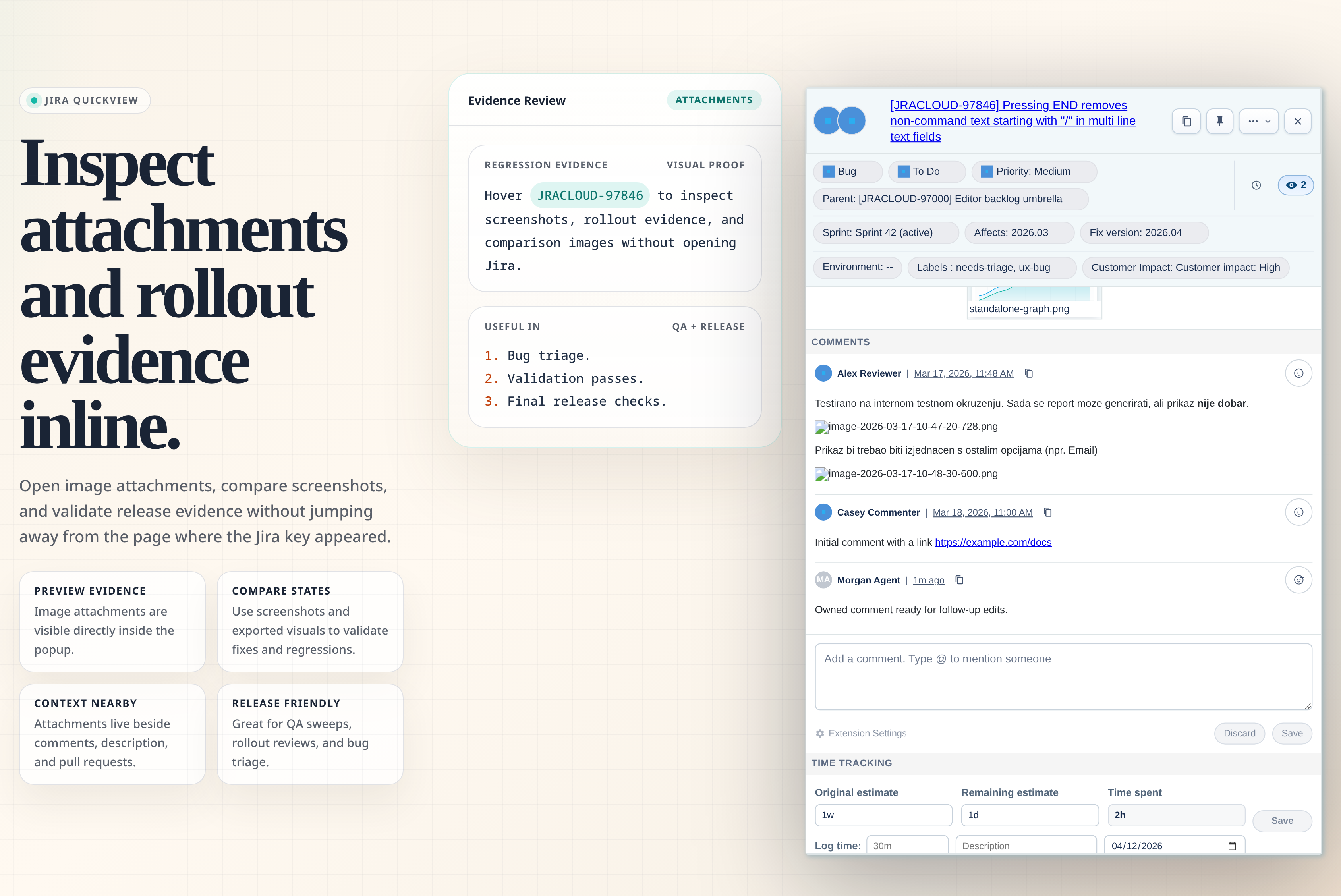
The Attachments block helps you inspect evidence without opening Jira and is enabled by default for new installations.
What you can do:
- Preview image attachments.
- See non-image files as compact entries with file type and size when Jira provides them.
- Open the full attachment in Jira.
- Use screenshot evidence during QA, release checks, bug triage, or support work.
Business logic and limitations:
- Images use the visual preview grid. Other file types remain visible and downloadable without pretending they have an image preview.
- Attachment visibility follows your Jira permissions.
5.10 Pull Requests Block
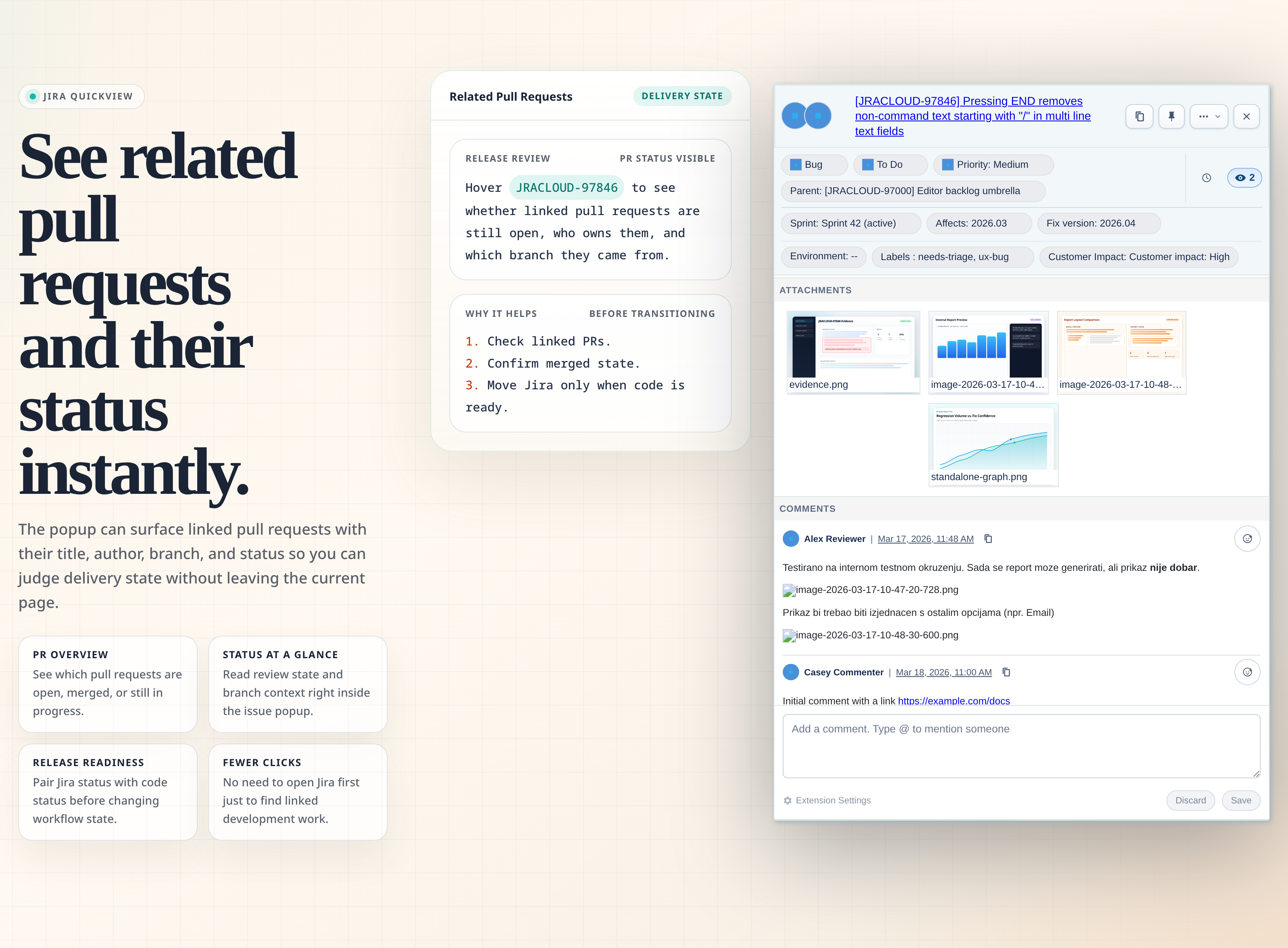
The Pull Requests block shows development work connected to the Jira issue.
What you can see:
- Pull request title
- Author
- Branch
- Status
- Link to open the pull request
Business logic and limitations:
- Pull request data comes from Jira development-status APIs.
- If Jira does not know about linked pull requests, the block will not show them.
- The current browser page is filtered out when it is the same pull request you are already viewing, which avoids showing a redundant link.
5.11 Comments and Reactions
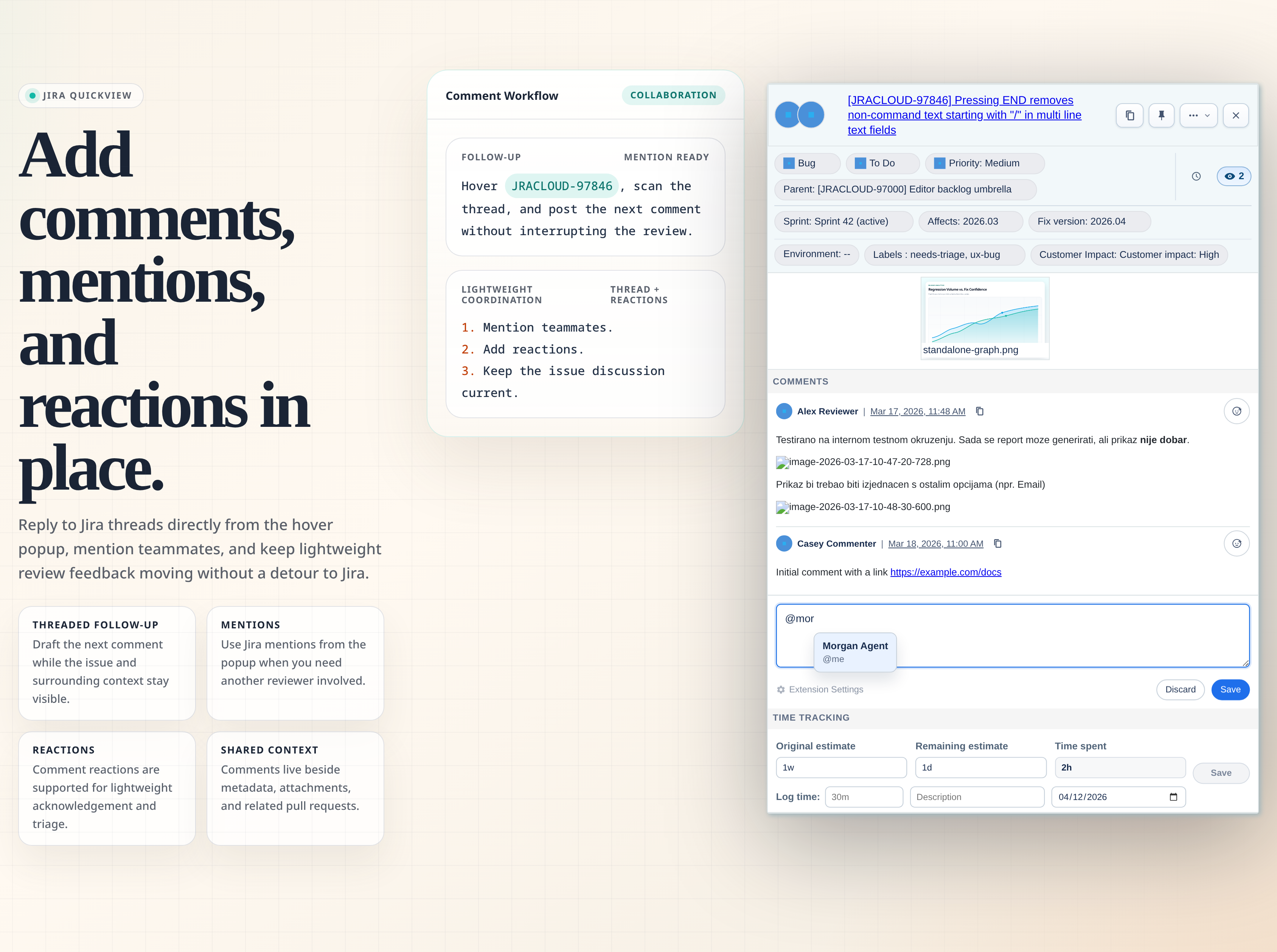
The Comments block lets you read and participate in Jira discussion from the popup.
What you can do:
- Read existing comments.
- Add a new comment.
- Type
@to mention someone. - Copy a direct comment link.
- Edit or delete your own comments when Jira allows it.
- Add supported reactions to comments.
Business logic and limitations:
- Comment permissions come from Jira.
- Mention search uses Jira user search around the current comment context.
- Comment reactions are shown only when the Jira instance supports the reaction flow used by the extension.
- Delete actions ask for confirmation inside the popup before applying the change.
6. Troubleshooting
Why Edit Buttons or Options Appear Only Sometimes
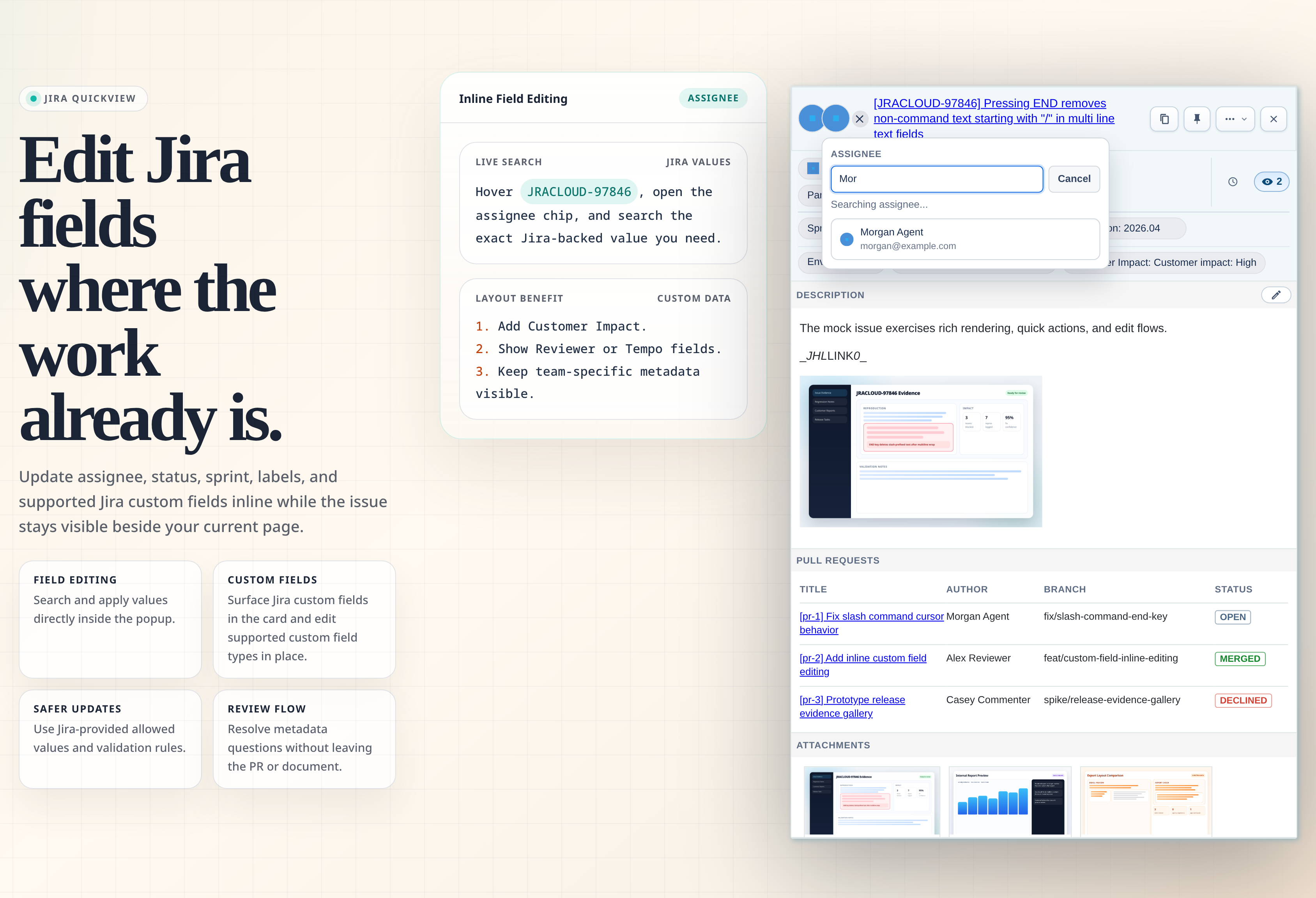
Jira QuickView intentionally does not show edit controls unless Jira says the action is valid for the current issue.
This depends on:
- Your Jira permissions
- The issue's project
- The issue type
- The current workflow status
- Required fields and workflow validators
- Jira edit metadata for the field
- Available Jira transitions
- Whether a field type is supported by Jira QuickView's inline editor
Important examples:
- Status choices are workflow transitions from the current status. They are not every possible status in the project.
- Assignee choices are assignable users for the current issue, not every Jira user.
- Sprint editing requires a valid sprint field and Jira Agile metadata.
- Labels require label suggestion support.
- Custom fields can be displayed even when their type cannot be edited inline.
If an edit button is missing, it usually means one of two things: Jira does not allow the edit for that issue, or Jira QuickView can display the field but does not yet support editing that field type.
The popup does not appear
Check these first:
- The current page is included in Allowed pages.
- You saved the Options page after changing settings.
- The page contains a genuine Jira issue link, or a recognizable issue key such as
ABC-123when hover preview is enabled. Open Jira issue links in QuickView instead of navigatingis enabled for click activation, or Hover preview is set to Automatic or With modifier.- You are pressing the configured modifier key after hovering when Hover preview is set to With modifier.
- You are signed in to Jira in the same browser.
- Your Jira instance is reachable from the browser.
The popup appears but issue data does not load
Likely causes:
- Jira URL is wrong.
- Jira session expired.
- VPN or company network is disconnected.
- The issue key does not exist in your Jira instance.
- You do not have permission to view the issue.
A field cannot be edited
This is usually expected. Jira QuickView honors Jira permissions, workflow rules, edit metadata, and supported field types. Try opening the issue in Jira itself. If Jira also prevents the edit there, the popup will not be able to do it either.
A user is missing from Assignee search
Assignee search is issue-specific. Jira may allow a person to watch an issue but not allow that person to be assigned to it. If Jira's own assignee picker shows the user and Jira QuickView does not, capture the exact Jira request URL from the browser Network tab and include it in a bug report. That URL helps compare Jira's own filtering with the popup's filtering.
Allowed page pattern does not match
Use simple values first:
github.commail.google.comoutlook.office.com
Then move to specific patterns:
https://*.your-company.com/*https://docs.your-company.com/projects/*
Remember that wildcard patterns use *. Do not write raw regex syntax unless you have verified how Chrome permissions and Jira QuickView normalization will treat it.
7. Suggested Daily Workflows
Triage from email
- Open a Jira notification in Gmail or Outlook.
- Hover the issue key.
- Check status, priority, assignee, linked issues, description, comments, and watchers.
- Assign to yourself, comment, or transition the issue if needed.
Review a pull request
- Open a GitHub pull request that mentions a Jira key.
- Hover the key.
- Check Jira status, linked PRs, comments, attachments, and history.
- Update status or comment without leaving the pull request.
Prepare a release
- Hover each issue key in a release checklist.
- Check fix version, status, linked Jira issues, linked PRs, attachments, and comments.
- Use History to verify recent changes.
- Update missing fields or comments before shipping.
Investigate a bug
- Hover the bug's issue key from a QA note or support page.
- Read the description, environment, labels, linked issues, attachments, and comments.
- Use History to understand recent changes.
- Add findings as a comment or update the description if Jira allows it.